Mix a little black powder into a plastic and nothing happens to its electrical behaviour. Keep adding it and, at some point, resistance collapses by many orders of magnitude over a narrow range of loading. That sudden change is the central fact of conductive plastics, and it explains why compounders argue so much about particle shape.
This piece looks at conductive carbon black from a materials-science angle: how it carries charge, why a threshold appears, how its geometry compares with graphite, carbon fiber and carbon nanotubes, and why hybrid networks that combine two fillers have become a serious route. Figures come from published filler-selection and grade data from a conductive compound maker, with background from standard reference entries on carbon black, carbon nanotubes and percolation.
How conductive carbon black carries charge
Wikipedia’s entry describes it as a good electrical conductor used as a filler, and also notes that it is added to polypropylene because it absorbs ultraviolet radiation that would otherwise degrade the material. Its low cost and stability are why it shows up in so many black plastic parts.
Inside a polymer, the aggregates rarely touch perfectly. Charge moves along aggregate chains and then hops or tunnels across the thin polymer gaps between neighbouring particles. Conductivity therefore depends less on the intrinsic conductivity of carbon than on how many of those gaps are narrow enough to cross.
The percolation threshold is a switch, not a dial
Percolation theory gives the language for that jump. Below a critical occupation probability, no connected cluster spans the system; above it, a giant connected component of the order of system size appears. For a finite sample, the probability of a top-to-bottom path traces a sigmoidal curve, and that curve sharpens as the sample grows relative to the particle spacing.
Translated into a compound, the threshold is the filler loading at which a continuous path first runs through the part. Below it, the plastic is an insulator with dark specks in it. Above it, resistance drops steeply and then flattens. Formulate a little above the threshold, not on it, unless the process window is unusually tight, because near the threshold tiny shifts in dispersion swing resistance by decades.
Geometry sets the threshold: four carbon fillers compared
Particle shape decides how much filler is needed to connect. A roughly spherical aggregate has to touch several neighbours; a long, thin tube can bridge a large distance by itself. Published selection data put typical thresholds at 10–20% for carbon black, 15–25% for graphite, 8–15% for carbon fiber and 1–5% for CNT.
| Filler | Geometry | Aspect ratio | Threshold (wt%) | Conduction mechanism |
|---|---|---|---|---|
| Carbon black | 0D spherical aggregate | Around 1 | 10–20% | Electron hopping / tunneling |
| Graphite | 2D platelet | 10–100 | 15–25% | Platelet face-to-face contact |
| Carbon fiber | 1D cylindrical fiber | 50–500 | 8–15% | Fiber-to-fiber contact |
| CNT | 1D tubular network | 100–1,000+ | 1–5% | Three-dimensional nano-network |
Lower thresholds do not automatically mean lower resistance. Those same data place surface resistivity at 10⁶–10⁹ Ω/sq for carbon black and graphite, 10²–10⁶ Ω/sq for carbon fiber and 10³–10⁷ Ω/sq for CNT. Carbon fiber reaches the lowest values, but only along the flow direction, because fibers align as the melt moves.
What high loading takes out of the polymer
Carbon black’s weakness is quantity. To build a reliable network, carbon black often needs 15-30% addition, depending on structure and resin. At that level the filler occupies a large share of the volume, and the comparison table on the same page lists impact down 40–60% and elongation down 70–90% for the carbon black route, with a significant drop in melt flow.
Heavy loading can also interfere with processing in less obvious ways. In one conductive POM guide-rail case, the old carbon black grade bloomed at elevated temperature, which capped mold temperature at 55 °C and prevented full crystallization. Its replacement CNT grade ran a 70 °C mold temperature instead, and rail wear after 100,000 reciprocating cycles fell from 0.08 mm to 0.03 mm, while the annual slide replacement rate moved from 35% to 8%.
Choose carbon black by default for cost-sensitive, textured black parts such as trays and work surfaces, unless the part needs toughness, gloss or a hot mold that high loading cannot give.
Carbon nanotubes: low loading, demanding dispersion
A carbon nanotube is a tube of carbon with a diameter in the nanometre range. Wikipedia notes that single-walled tubes have diameters around 0.5–2.0 nanometres, and that some structures conduct strongly while others behave as semiconductors. Their length relative to that diameter is what makes them efficient bridges.
Because the aspect ratio is so high, CNT can form a conductive network at 2-5% loading in many systems. Less filler leaves more polymer, which preserves impact and surface finish. Dispersion is the hard part: tubes arrive tangled, and a poorly dispersed batch behaves like a much higher-threshold filler.
Here is the counterintuitive part. CNT is the most expensive of the four fillers per kilogram, yet the selection guide argues that for CNT the right comparison is often cost per finished part, not compound price per kilogram, because low loading can reduce scrap. Judge a nanotube grade on accepted parts, not on the price line of a pellet quote.
Why mix carbon black with nanotubes
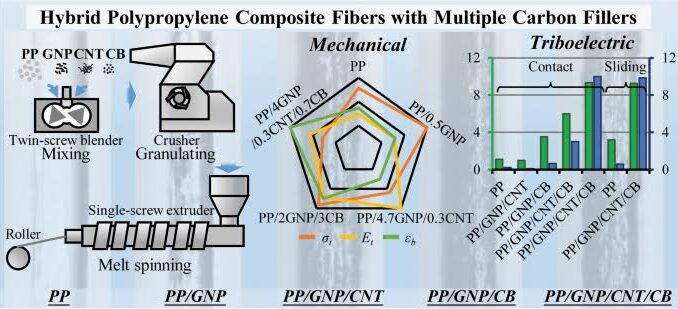
Combining carbon black with nanotubes lets their percolation behaviours work together, and the shielding-fabric guide describes this hybrid direction as the best balance between conductivity and processability. In polypropylene, carbon nanotube grades build the network at 3–8 wt%, which leaves enough melt flow for thin film. DGK-PP DD35A is an example of the combined route: a carbon black / CNT hybrid film grade at 10³–10⁵ Ω/sq with a 12–18 g/10min melt flow index.
Pure carbon black at a comparable resistance would need far more filler and would struggle to extrude thin film. Researchers and product teams looking at where such hybrids fit among other carbon systems can compare published Carbon Nanotube and Carbon Black Hybrid Plastic Compounds data against single-filler routes before choosing a test matrix.
Where it stops: dispersion quality. A hybrid only works if both fillers are evenly distributed; agglomerated tubes simply become expensive carbon black.
What one molded-housing trial shows
Filler theory meets reality in molded parts. In a handheld tester-housing study, DEYU Plastics compared routes on 300 molded housings across 5 molding cycles rather than on flat plaques. Targets were set at 10^6-10^8 ohm/sq, notched Izod above 6 kJ/m2 and gloss above 60.
- 18% carbon black ABS: 4 x 10^7 ohm/sq, impact 5.2 kJ/m2, gloss 48.
- 3% CNT ABS: 2 x 10^6 ohm/sq, impact 7.2 kJ/m2, gloss 68.
- Carbon black 12% + carbon fiber 3%: 3 x 10^7 ohm/sq, impact 6.5 kJ/m2, gloss 52.
Read the numbers without a verdict first. All three landed inside the resistance window. Only the nanotube route cleared both the impact and gloss targets, although the study notes it went over the cost target; the carbon black and carbon fiber blend cleared impact but sat below the gloss target. That blend is not a nanotube hybrid at all, which is a useful reminder that “hybrid” names a strategy, not one formula.
Even a balanced system shifts when flow length, weld line position and holding pressure change, so the recommended follow-up was production validation with adjusted gate location and a larger batch.
Where it stops: plaques. Resistance and gloss measured on a flat specimen say little about a housing with ribs, bosses and a weld line; test the geometry that will ship.
Specifying a conductive filler system
- Surface resistance or volume resistivity target, with its test method and measurement location.
- Governing mechanical property: notched impact, tensile, flexural modulus or wear.
- Process, section sizes, flow length and gate plan.
- Appearance class, from textured black to high gloss.
- Commercial model: cost per kilogram or cost per accepted part.
For labs and small teams, entry cost matters. Orders for the CNT compound pellets can start at 5 kg, with 3-5 day rapid sampling for R&D validation, and DEYU Plastics engineers can visit customer plants to fine-tune injection molding parameters when a trial moves onto a production press.
Batch consistency is the other number worth asking for. On its CNT PP grade the company keeps batch-to-batch resistivity CV within 20% with full traceability, a figure that matters more near the threshold than any single resistance reading.
Conductive carbon black remains the workhorse because it is cheap and forgiving. Nanotubes earn their place where loading has to stay low, and hybrids sit between the two. Pick the network by the property the part cannot give up, then confirm it on molded parts.
Leave a Reply