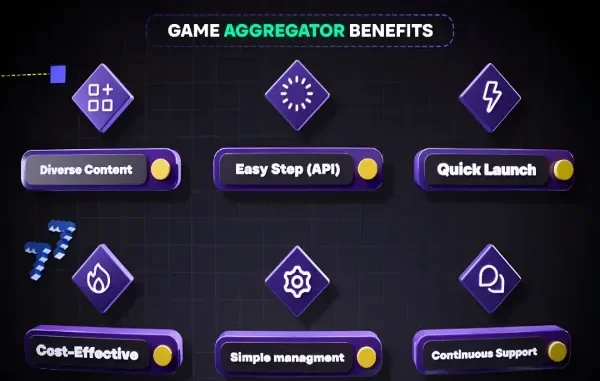

In today’s fast-paced world of virtual gaming, launching a platform quickly is essential yet challenging. However, game aggregation software helps make this process much easier and faster. It connects many game providers into a single system, so that you do not have to deal with every provider separately.
Thus, accelerating the setup process and easing the testing process. But, how does it do it? Continue reading, and in the forthcoming content, we will discuss how Game Aggregation software accelerates launch times, eliminates technical bottlenecks, and streamlines the development process to enhance the time-to-market for virtual gaming operators. Let’s begin.
What is Time-to-Market in Virtual Gaming?
Time-to-Market in virtual gaming refers to the total amount of time needed to move from one platform planning to a fully operational gaming product. This includes all the components from technical integration, testing compliance alignment, content onboarding, and system stabilization.
In the past, launching a virtual gaming platform required an immense amount of time to develop and integrate each game provider individually.
Every provider used to come with its own API specification, certification requirements, and testing workflows. However, Game Aggregation software has changed the working process today.
The Traditional Integration Model and Its Limitations
Before such software became practical, operators had to:
- Negotiate and integrate each provider separately.
- Build custom API connections.
- Handle provider-specific wallet logic.
- Perform repetitive QA and testing cycles.
Each new provider would consume weeks or even months to launch the timeline. In addition, any change or update needed requires rework across all the integrations. As a result, rapid launches were next to impossible.
How Game Aggregation Software Fasten Platform Launches
Through Game Aggregation Software, one can form a whole ecosystem of games and integrations to accelerate the game launch. It works on several factors, including:
Single API Integration Instead of Multiple Builds
Operators can integrate with the aggregator software instead of building separate integrations for every provider. Thus, reducing the time needed for development, as the platform only needs to adhere to a single API specification.
At the same time, all the provider-specific logic is handled by the aggregation layer itself. Hence, operators need to focus on core platform features, rather than wasting time on low-level integrations.
Faster Game Content Onboarding
With such software, one can add games without technical involvement from the operator. Once the aggregator software integrates a new provider, each and every game associated with them becomes available through the same API.
Hence, content expansion is easier and instant. It also enables operators to launch with game libraries from the first day, instead of rolling out for months.
Reduced Testing and Certification Cycles
Testing is one of the most time-consuming phases of virtual gaming platform launches. Without aggregation, each provider integration must be tested independently.
Game Aggregation software centralizes testing requirements. Operators only have to validate the aggregator’s API once, while the aggregator handles provider-level testing internally. This testing approach shortens the total QA timelines and reduces pre-launch friction.
Parallel Development and Faster Readiness
One of the most overlooked advantages of Game Aggregation is parallelization. Because the aggregation layer abstracts provider complexity, operators can develop:
- Frontend user experience
- Player account systems
- Payment infrastructure
- Marketing and CRM tools
This overlap eliminates idle development time and compresses overall launch schedules.
Rapid Expansion After Initial Launch
Time-to-market does not end at launch. Post-launch agility is equally important. Game Aggregation software allows operators to:
- Add new providers without platform downtime
- Expand into new regions quickly
- Respond to market trends with minimal delay
This continuous acceleration ensures operators are not slowed down by technical dependencies as they grow.
Simplified Platform Maintenance and Updates
Adhering to the maintenance requirements can be tricky and difficult sometimes, especially when you have a wide variety of games. This can also deteriorate the time-to-market for new features. However, with Game Aggregation software:
- Provider updates are handled centrally
- API changes do not cascade into the operator’s system
- Platform updates remain isolated and controlled
As a result, operators can deploy enhancements faster and with a much lower risk than usual.
Operational Readiness Through Centralized Control
Game Aggregation Software provides a standard configuration for game availability, jurisdiction rules, currency, and language settings.
As these controls are present at the aggregation layer, operators can configure launch-ready environments without touching code. Thus, compressing the operational flexibility further compresses the launch timelines.
Lower Technical Dependency on Provider Timelines
Direct integrations bind the operators with the provider development schedules. Therefore, any delays from the provider’s side can have a huge impact on the operator’s launch.
However, the Game Aggregation software helps to prevent this dependency. Providers are integrated separately by the aggregator, which allows the operators to move forward without waiting for separate studios.
Competitive Advantage of Faster Market Entry
Speed is more strategic, rather than being operational. Operators that launch faster can do:
- Capture early player acquisition
- Test markets sooner
- Iterate products ahead of competitors
Game Aggregation software turns technical efficiency into a tangible competitive advantage.
Long-Term Time-to-Market Optimization
Game Aggregator software helps operators to maintain improvement in their platform over time. Instead of slowing down as new games, providers, or features are added, the software makes it easy to grow.
- Supporting Rapid Scaling: The software allows platforms to handle more games and more players without requiring any technical changes.
- Reducing Integration Debt: Adding new providers or features one followed by the other can create messy code and difficulty in maintenance, which is known as the integration debt. Game Aggregation software handles these additions in one layer so that the operator’s system stays simple and clean.
- Enabling Faster Experimentation: Operators can test new games and features quickly as the aggregator handles all the complex tasks at the backend.
Conclusion
Game aggregation software has fastened the launch times for virtual gaming. Forming a single layer, it prevents delays and facilitates fast launches.
Everything from faster development to instant expansion, the software transforms time-to-market from a constraint into a strength.
Leave a Reply