AI music platforms are often discussed as though they all do the same thing with different branding. A user types something, a song appears, and the comparison ends there. But in actual use, the more important difference is often not whether a platform can generate music at all. It is whether the platform helps users choose the right kind of generation for the job in front of them.
This is where ToMusic becomes more interesting than a generic text-to-song tool. Rather than presenting everything as one hidden engine, it makes model choice part of the experience. The platform offers V1, V2, V3, and V4, each positioned with a different emphasis. That design tells users something valuable from the start: there is no single definition of “best” output. A fast sketch, a richer arrangement, and a stronger vocal performance may require different priorities.
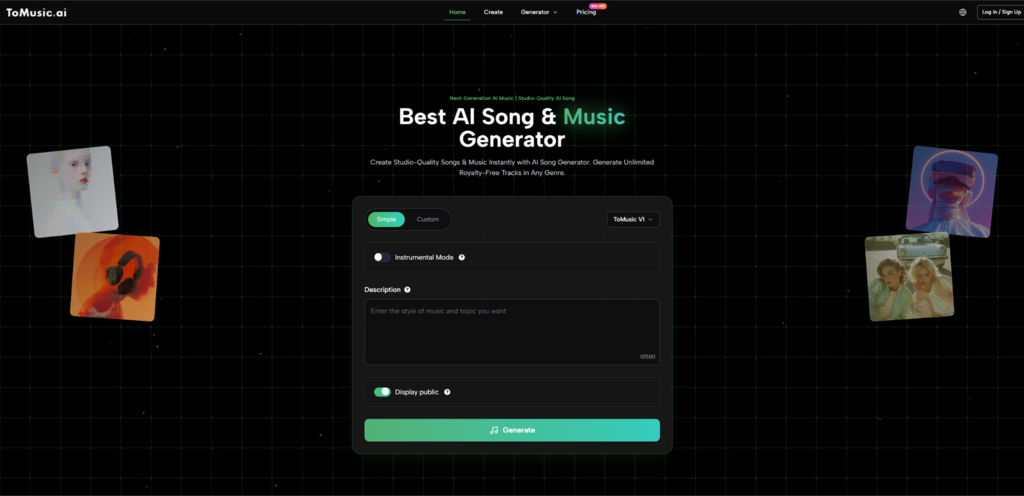
For someone encountering an AI Music Generator for the first time, that distinction may feel secondary. But in practice, it shapes the entire user experience. A platform becomes easier to trust when it admits that different creative tasks deserve different tools.
Why One Model Rarely Fits Every Musical Task
Music creation is not one activity. It is a cluster of activities. Sometimes a user wants to hear whether an idea has emotional potential. Sometimes they want to test a chorus. Sometimes they need a background track with a certain atmosphere. Sometimes they want a more complete vocal-led result. If one model handles all of these equally, that is impressive. In reality, most systems perform better in some zones than others.
ToMusic’s multi-model structure gives users a practical way to think about that. Instead of asking, “Can this platform make music?” the better question becomes, “Which generation path is most aligned with what I need right now?”
Why V1 Feels Like A Speed Tool
V1 appears to work well as a quick entry point. It supports shorter generation and feels suited to fast drafting. For creators who want to validate mood or structure quickly, that matters.
Why V2 Feels More Atmospheric
V2 seems aimed at fuller ambience and more expanded layering. That makes it useful when the user is trying to find a sonic environment rather than just a melody idea.
Why V3 Suggests More Musical Density
V3 leans into richer harmony and more complex arrangement behavior. This makes it appealing for users who want something that feels a little more compositionally developed.
Why V4 Targets A More Finished Impression
V4 is positioned around more realistic vocals and stronger control. In my view, that makes it the model that most directly serves users chasing a more polished draft rather than a loose concept sketch.
How Model Choice Changes Creative Behavior
The biggest benefit of multiple models is not technical. It is behavioral. People make better creative decisions when they know what dimension they are optimizing for. Without that awareness, users often blame themselves for weak output when the real issue is that they asked the wrong mode to do the wrong job.
A singer-songwriter, for example, may value vocal realism above all else. A video creator may care more about mood and pacing than about lyrical performance. A marketer may simply need multiple tonal variations for testing. These users are all making music, but they are not solving the same problem.
A Useful Way To Read The Product Architecture
ToMusic becomes easier to understand when seen as a combination of two choices:
- What is your starting material?
- What kind of output quality matters most in this session?
The first choice is between prompt-led creation and lyrics-led creation. The second is model selection. Once those decisions are made well, the rest of the workflow becomes much more coherent.
How Prompt-Led And Lyrics-Led Sessions Differ
The platform lets users begin from descriptive prompts or from lyrics. That is more than a convenience feature. It defines two different creative modes.
Prompt-Led Sessions Are About Atmosphere First
This path suits users who know the sonic direction they want but do not yet have words. It is useful for concept music, background composition, mood exploration, and fast creative sketching.
Lyrics-Led Sessions Are About Meaning First
This route serves users who already have language and want to hear it embodied in music. In many cases, this feels closer to songwriting than to soundtrack generation.
Why That Difference Matters
A user who begins with lyrics is evaluating cadence, phrasing, chorus shape, and emotional delivery. A user who begins with a prompt may care more about sonic identity, pace, and arrangement feel. The same tool must serve both, but the expectations are different.
A Three-Step Workflow Built Around Choice
The official use flow is fairly direct, and that simplicity helps.
Step 1. Pick The Model That Matches The Task
The user selects V1, V2, V3, or V4 based on whether the goal is speed, layering, arrangement richness, or stronger vocal realism.
Step 2. Enter A Prompt Or Lyrics
The next step is providing the creative input. That can include genre, mood, tempo, instrumentation, vocal direction, or full lyrics depending on the route.
Step 3. Generate, Listen, And Compare
The result is generated and then reviewed. This stage is where users start learning which model actually works best for their recurring needs.
How Comparison Creates Better Judgment
The real strength of a multi-model system is comparison. A user can run similar ideas through more than one model and listen for what changes. One version may sound emotionally stronger. Another may feel cleaner but less distinctive. That kind of contrast teaches more than any feature description.
| Creative Goal | Better Starting Model | Main Advantage |
| Quick idea check | V1 | Fast iteration |
| Mood-heavy exploration | V2 | Richer atmosphere |
| Arrangement testing | V3 | Stronger musical density |
| Vocal-forward drafts | V4 | Better performance feel |
This kind of comparison does not lock users into rigid formulas. It simply reduces random trial-and-error.
Why Lyrics-Based Work Deserves Its Own Lens
The phrase Lyrics to Music AI deserves more attention than it usually gets. Lyrics-led generation is not just a feature variant. It is a different way of developing a song. When a creator starts from written words, they are testing whether the language can survive melody, timing, and performance.
This can be revealing in ways that static text cannot. A line that reads well may sing poorly. A chorus that looks strong may fail to rise. A verse may become overcrowded when phrased aloud. By converting text into a performed draft, the platform helps writers assess whether their lyrical structure actually supports music.
Why Writers Benefit From Model Choice Too
A lyrical idea may sound intimate in one model and overproduced in another. One model may support the emotional tone better. Another may expose where the lyrics need rewriting.
Why This Process Helps Even If The Draft Is Not Final
The point is not always to keep the generated version. Sometimes the value lies in hearing what needs to change next.
What The Music Library Adds To The Experience
ToMusic stores generated tracks in a music library along with related metadata. This archive matters because model comparison loses value if results are not easy to revisit. Saved drafts let users observe patterns. They can return to a stronger version, compare two model outcomes, or note which kind of prompt produced the best structure.
Why Memory Makes The Product More Useful
A creative platform becomes more than a novelty when it supports recall. Saved context turns accidental success into something closer to a repeatable method.
Why This Supports Strategic Use
Users who work repeatedly with music, whether for content, songwriting, or brand projects, benefit from being able to trace how output quality changes across models and prompts.
Where Users Should Stay Grounded
No model structure removes the need for trial, listening, and revision. Results still depend on the clarity of the brief. Some generations will miss the intended emotional target. Others may feel impressive on first listen and weaker on repetition. This is normal.
The right expectation is not flawless automation. The right expectation is faster convergence. A multi-model platform helps users get closer to the right answer sooner by making creative trade-offs visible.
Why Honest Expectation Leads To Better Use
People tend to get more value from systems like this when they treat generation as exploration instead of final judgment. A draft can still be useful even when it is incomplete.
Why The Product Feels More Mature Because Of This
ToMusic feels more thoughtfully designed precisely because it does not reduce creativity to one button. It gives users structured choices, and structured choices often produce better outcomes than bigger promises.
Why This Matters For AI Music Going Forward
The future of music generation may depend less on one model becoming perfect and more on platforms helping users navigate different kinds of creative needs intelligently.
Why ToMusic Works Best As A Decision Tool
Seen from a distance, ToMusic is a platform that turns words into music. Seen more closely, it is a platform that helps users make better decisions about how words should become music. That second description is more important. It shifts the product from spectacle to workflow.
For creators who understand that the first question is not “What can AI do?” but “What kind of draft do I need right now?” the platform becomes much easier to use well. And in creative work, good decisions early in the process often matter more than impressive results at the end.
Leave a Reply