Sitting is not a rest position. That is the first thing the research literature establishes and the last thing furniture marketing acknowledges. It explains almost everything about why a stool that felt fine in a showroom becomes intolerable somewhere in the second hour.
The mechanics of perching on an elevated seat with no back and the feet off the floor are different from the mechanics of sitting in a chair, and they are worse in specific, predictable ways. Understanding what happens to a body on bar stools over two hours turns a comfort argument into a set of dimensions.
Sitting Is Loaded, Not Relaxed
Start with the framing, because it is counterintuitive.
Biomechanics treats the seated body as a structure under load rather than as a body at rest. Weight that was distributed across the feet and legs while standing gets concentrated onto a small area of the pelvis, and the spine loses the support it had from an upright posture.
That concentration is the whole problem. It is why sitting is comfortable briefly and uncomfortable eventually. The duration at which that change happens is a function of how the load is distributed rather than of how soft the seat is.
The Feet Are Doing More Than Anybody Realizes
The second point is the one that separates a stool from a chair.
In a chair the feet are flat on the floor and they carry a meaningful share of the body’s weight. That share is not large, and removing it changes the loading on the pelvis substantially.
On a stool with no footrest, or with a footrest at the wrong height, the legs hang. All of the weight goes onto the seat, and the thighs take a further load at the front edge because there is nothing supporting them.
This is why the footrest is not a comfort feature. It is a load path, and a stool without a working one is asking the pelvis to carry everything for two hours.
The Front Edge Is Where Failure Starts
The third point is about the seat profile and it is the most common design error.
A seat with a hard front edge presses across the back of the thigh, close to where major vessels and nerves run. Over a short period that is nothing. Over an hour it produces the numbness and shifting that people attribute to boredom.
A waterfall or dished front removes the pressure line by curving away from the leg. That single geometric decision is worth more to two-hour comfort than any amount of padding, and it costs nothing extra to specify.
Static Posture Is the Underlying Problem
The fourth point unifies the others and it is well established in occupational research.
Federal ergonomics work through NIOSH and workplace guidance from OSHA keep returning to the same finding. Sustained static posture is harder on the body than moderate movement, and the remedy is variety rather than cushioning.
A backless stool permits almost no variety. There is one position, it loads the same tissue continuously, and the only available change is standing up. That is precisely what a bar does not want its guests doing at the fifty-minute mark.
What Backs and Arms Actually Change
The fifth point follows directly and it is the most actionable.
A back, even a low one, adds a second posture. The guest can lean, which shifts load off the pelvis onto the spine and back again, and that alternation is what extends comfortable duration substantially.
Arms add a third. They also give older guests and anybody with limited mobility something to push up from, which is the difference between rising easily and making a small production of it in a public room. That difference decides who comes back.
Neither is a luxury specification. Both are load paths, and a stool run with backs on a proportion of the positions is a room that can hold people for two hours rather than one.
The Dimensions That Follow From the Mechanics
The sixth point is that all of this reduces to four numbers.
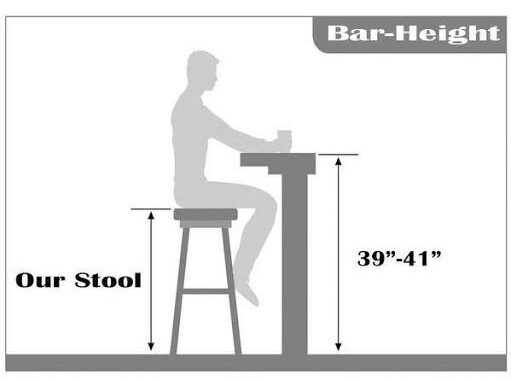
Seat height matched to the counter, leaving ten to twelve inches of clearance to the underside. A footrest at ten to twelve inches below the seat, wide enough and strong enough to carry real weight rather than to rest a toe on. A seat depth that supports the thigh without pressing behind the knee. A front edge that curves away.
Get those four right and the two-hour problem largely disappears. Get any one wrong and no amount of upholstery compensates, because the failure is a loading problem rather than a softness problem.
What to Check on a Sample
For an operator evaluating a stool against a two-hour occupancy:
- Sit in it for ninety minutes, not two, in the counter it will actually pair with
- Measure the footrest height below the seat and stand on it with full weight
- Check whether the front edge has a curve or a line, with a hand rather than an eye
- Confirm the seat supports the thigh without contacting behind the knee
- Test a backed version alongside a backless one over the same period
- Note the minute at which you first shift position, and the minute you first stand
Why the Showroom Test Fails
The reason so many bars end up with stools nobody sits on for long is that every stool is comfortable for ten minutes.
The mechanics that separate them do not engage until the tissue under the pelvis has been loaded for a while. That point arrives long after a buyer has formed an impression and moved on to the next product. The showroom is testing the wrong thing at the wrong duration.
What the research offers is a way to predict the outcome from dimensions instead of waiting for it. Four measurements, taken with a tape, tell you more about the second hour than an afternoon of sitting on samples for two minutes each, and they are available before anybody signs an order.
Leave a Reply