
Football has never generated more data than it does today. Every pass, sprint, duel, shot, recovery, and tactical adjustment can now be measured, visualised, and compared. Clubs invest heavily in analytics departments, broadcasters fill match coverage with advanced metrics, and supporters increasingly discuss expected goals, pressing intensity, and possession quality alongside traditional statistics.
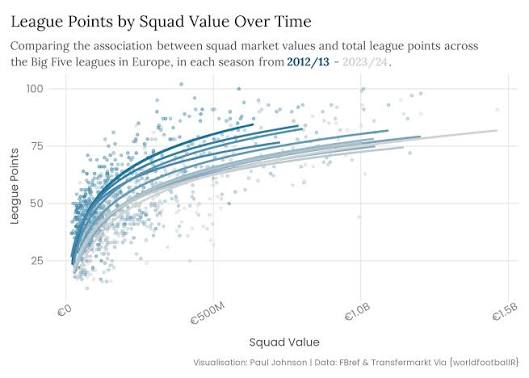
One question, however, continues to divide analysts and fans alike: does having the most expensive squad actually lead to better performances?
At first glance, the answer appears obvious. Wealthier clubs generally attract better players, and better players usually produce better results. Yet modern football analytics suggests the relationship is far more nuanced. Market value represents potential, but efficiency determines whether that potential is converted into success.
Market Value Is Only the Starting Point
A squad’s transfer value is often treated as a shortcut for quality. While financial resources undoubtedly influence competitiveness, market value alone rarely explains why one team consistently outperforms another.
Several factors shape performance beyond the transfer market:
● Tactical organisation.
● Coaching quality.
● Player availability.
● Squad chemistry.
● Physical conditioning.
● Decision-making under pressure.
● Fixture congestion.
A team worth hundreds of millions of euros can struggle if these elements fail to work together. Meanwhile, a less expensive squad with excellent coaching and a clearly defined tactical identity may consistently exceed expectations.
Researchers studying European football have shown that team value influences performance, but efficiency depends on how effectively available resources are transformed into points on the pitch rather than financial investment alone.
Measuring Efficiency Instead of Reputation
Modern analysts increasingly focus on efficiency rather than reputation.
Instead of asking whether a club possesses expensive players, they ask whether those players consistently create value during matches.
This involves analysing numerous performance indicators, including:
● Expected goals (xG).
● Shot quality.
● Progressive passing.
● Defensive recoveries.
● Pressing success.
● Ball progression.
● Chance creation.
● Transition efficiency.
Viewed together, these metrics often reveal patterns that the final score alone cannot capture.
For example, two teams may both win 2–0, yet one could dominate every underlying statistic while the other relies heavily on excellent goalkeeping and clinical finishing. Over a full season, those differences usually become increasingly significant.
When Multiple Datasets Tell the Same Story
Individual statistics rarely provide complete answers.
This is why analysts increasingly combine several performance indicators to understand how teams function as complete systems. Betano’s Football Under the Microscope illustrate this broader approach by bringing together market values, efficiency indicators, and team statistics to examine whether financial strength consistently translates into performance on the pitch.
Rather than focusing on one isolated number, combining different datasets makes it easier to identify clubs that consistently outperform expectations as well as those whose expensive squads fail to deliver proportionate results.
The same principle is becoming standard throughout professional football analysis, where multiple performance variables are evaluated together instead of relying on simple league tables or transfer spending.
Context Changes Everything
Raw numbers can easily become misleading without proper context.
A striker who scores twenty goals for a title contender operates in completely different circumstances from one playing for a newly promoted club. Likewise, defensive statistics often depend heavily on tactical approach rather than individual ability.
Successful analysis therefore considers questions such as:
● Was possession deliberately surrendered?
● How strong was the opposition?
● Did injuries force tactical changes?
● Was the match state influencing decisions?
● How many chances were actually created?
Ignoring context frequently produces incorrect conclusions.
This explains why professional analysts rarely judge performance using only goals, assists, or possession percentages.
The Rise of Football Data Science
Football has increasingly embraced techniques long used in other scientific disciplines.
Machine learning, probability models, predictive algorithms, and statistical simulations now support decision-making throughout elite football.
Expected goals remain among the best-known examples, but they represent only one element of a much larger analytical ecosystem.
Modern clubs also examine:
● Passing networks.
● Space occupation.
● Press resistance.
● Ball progression.
● Defensive compactness.
● Sprint intensity.
● Player workload.
● Win probability models.
Sports analytics has evolved into an interdisciplinary field combining statistics, mathematics, computer science, and tactical expertise to better understand performance and decision-making.
Why Betting Markets Also Interest Researchers
Interestingly, betting markets have become valuable research tools for sports scientists.
Rather than viewing odds purely as betting products, researchers increasingly study them because they aggregate enormous amounts of publicly available information. Injuries, historical performance, tactical strength, squad quality, and countless other variables become reflected in market expectations.
Academic work has demonstrated that betting odds can provide useful information for football performance analysis by helping distinguish underlying team strength from actual match performance.
This does not mean markets predict every result correctly. Football remains an unpredictable sport where individual moments can change everything. Instead, odds offer another dataset that analysts can compare with traditional football metrics.
Expensive Teams Can Still Be Inefficient
Football history contains countless examples of wealthy clubs underperforming despite assembling star-studded squads.
Common reasons include:
● Tactical inconsistency.
● Frequent managerial changes.
● Poor squad balance.
● Injuries.
● Lack of chemistry.
● Recruitment mistakes.
Meanwhile, several clubs with comparatively modest budgets have consistently exceeded expectations through intelligent recruitment, effective coaching, and clearly defined playing philosophies.
Efficiency therefore measures something different from financial power.
It evaluates whether available resources are being converted into successful performances as effectively as possible.
Looking Beyond Goals
Supporters naturally remember goals because they decide matches.
Analysts, however, often pay equal attention to everything happening before those goals occur.
Questions include:
● How did possession reach dangerous areas?
● Which passing sequences created space?
● How often did pressing force turnovers?
● Were attacks sustainable throughout the match?
● Did defensive positioning limit high-quality chances?
These observations frequently explain future performance more accurately than isolated moments of brilliance.
As football becomes increasingly data-driven, understanding these underlying processes has become almost as important as analysing the final score itself.
Balancing Numbers With Human Judgement
Despite rapid technological progress, football analysis has not become entirely mathematical.
Experienced scouts still identify qualities that remain difficult to quantify, including leadership, communication, resilience, creativity, and decision-making under pressure.
Likewise, coaches combine analytical reports with tactical knowledge, player psychology, and experience accumulated over decades.
The strongest organisations rarely choose between data and human judgement.
Instead, they integrate both.
Analytics identifies patterns that might otherwise remain hidden, while experienced professionals provide the football context necessary to interpret those patterns correctly.
Football’s Data Revolution Is Still Evolving
The explosion of available football data has transformed how clubs, analysts, broadcasters, and supporters understand the game.
Market values remain useful indicators of squad quality, but they tell only part of the story. Efficiency, tactical execution, player development, and contextual performance often explain success far better than financial investment alone.
As new analytical methods continue to emerge, football will become even better at separating perception from measurable performance. Rather than replacing traditional understanding of the sport, data enriches it by revealing patterns that were previously invisible.
Ultimately, football remains wonderfully unpredictable. Statistics cannot eliminate uncertainty, nor should they. What they can do is provide a deeper understanding of why certain teams consistently outperform expectations while others fail to convert expensive talent into lasting success. That combination of evidence, interpretation, and human judgement is what makes modern football analytics one of the most fascinating developments in contemporary sport.
Leave a Reply