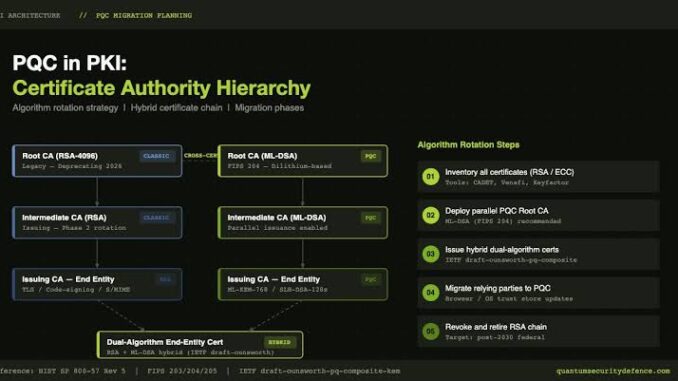
In August 2024, NIST finalized the first three post-quantum cryptography standards after roughly eight years of public evaluation. That moment functioned as a starting gun for enterprises everywhere, even though most organizations are still working out what it actually means for their own infrastructure.
The standards themselves are not optional reading material for a future project. They are the concrete target enterprises now need to plan against, since vendors, regulators, and partners are all beginning to ask the same question: what is your timeline for adopting these algorithms.
What PQC Algorithms Are and Why They Matter
Post-quantum cryptography refers to a new generation of encryption and signature algorithms built on mathematical problems that remain hard even for a sufficiently powerful quantum computer. A clear overview of PQC algorithms for encrypted communications explains the core concepts without requiring a background in advanced mathematics, which makes it a useful reference before diving into specific migration decisions.
The urgency comes from a threat that does not require a working quantum computer to exist yet. Adversaries can capture encrypted traffic today and simply store it, waiting for decryption capability to arrive later. Data that needs to stay confidential for a decade or more is already at risk under this model, regardless of how far away large-scale quantum computers actually are.
The Three Algorithms Enterprises Need to Know
NIST’s finalized standards cover three core algorithms, each addressing a different part of the cryptographic stack. ML-KEM handles key encapsulation, the mechanism used to establish a shared secret between two parties, and is likely to see the broadest adoption since it replaces the key exchange step in protocols like TLS.
ML-DSA and SLH-DSA both handle digital signatures, but they take different approaches. ML-DSA is built on structured lattice problems and offers a strong balance of performance and signature size for most use cases. SLH-DSA relies on hash-based techniques instead, trading larger signature sizes for an extremely conservative security foundation that some organizations prefer for their most sensitive systems.
Enterprises generally do not need to choose just one. Many migration plans call for ML-DSA as the default signature algorithm, with SLH-DSA reserved for a smaller set of systems where the added conservatism justifies the performance cost.
A fourth algorithm, HQC, was more recently selected as a backup key encapsulation method built on a different mathematical foundation from ML-KEM. Its purpose is largely insurance: if a future weakness were ever discovered in the lattice-based math underlying ML-KEM, having a structurally independent alternative already standardized would prevent the entire ecosystem from starting over.
Performance and Compatibility Tradeoffs
Every one of these algorithms comes with larger keys and signatures than the classical algorithms they replace, and that size difference is not a minor implementation detail. Network protocols, certificate formats, and hardware with fixed memory budgets were all designed around the smaller key sizes of RSA and elliptic curve cryptography.
Embedded devices and legacy systems tend to feel this tradeoff most acutely. A microcontroller with limited memory may struggle to accommodate a larger signature, and protocols that assume a fixed packet size can require rework just to carry the new key material. This is one reason migration timelines for large enterprises commonly stretch well beyond a single budget cycle.
Hybrid approaches have become the practical answer to this transition period. Running a classical algorithm alongside a post-quantum one during the same handshake preserves compatibility with systems that have not yet been upgraded, while still gaining protection against the harvest-now, decrypt-later threat for any system that supports the new algorithms.
Building a Migration Roadmap
A successful migration starts with visibility rather than algorithm selection. Most enterprises cannot currently produce an accurate inventory of where cryptography is actually used across their systems, which makes prioritization guesswork rather than a deliberate risk-based decision.
Industry coverage of this gap has been growing steadily. Enterprise security migration reporting on the topic has highlighted that security leaders are increasingly pushing vendors directly for PQC readiness roadmaps, treating the absence of a clear vendor timeline as a procurement red flag rather than a minor gap.
Once an inventory exists, prioritization usually follows data sensitivity and lifespan rather than technical convenience. Systems protecting data with long confidentiality requirements, such as intellectual property or long-term contracts, typically move to the front of the queue ahead of systems handling shorter-lived transactional data.
Staffing is often the quieter constraint behind a slow rollout. Few enterprises have engineers with deep cryptographic expertise on staff, and the specialized knowledge needed to validate a migration plan, rather than simply execute a vendor’s instructions, remains genuinely scarce across the industry.
Extending Readiness to the Supply Chain
An enterprise’s own migration progress only protects data that stays entirely within its own systems. Much of the data enterprises care about flows through suppliers, partners, and third-party platforms that may be on a completely different migration timeline, or may have no plan at all.
This dependency has started showing up explicitly in procurement conversations. Supply chain risk reporting on the topic notes that organizations are beginning to factor PQC readiness into vendor assessments and contract requirements, recognizing that a partner’s unpatched cryptography can undermine an otherwise solid internal migration.
Cyber insurance underwriters are starting to ask similar questions, which adds another practical incentive for enterprises to treat PQC migration as a documented, ongoing program rather than a one-time technical project.
Setting Realistic Expectations for the Transition
Migrating to post-quantum algorithms is rarely a single coordinated cutover. It tends to unfold gradually, system by system, over a period that can stretch from a few years for organizations with strong cryptographic agility to well over a decade for those still working through deep legacy technical debt.
That timeline is not a reason to delay getting started. The organizations with the smoothest transitions tend to be the ones that began their cryptographic inventory and prioritization work years before any hard deadline arrived, treating the NIST standards as a planning trigger rather than a problem to revisit later.
Frequently Asked Questions
How long does a typical PQC migration take?
It varies widely by organization size and legacy system complexity, ranging from roughly two to three years for crypto-agile environments to a decade or more for organizations with extensive hardcoded cryptography in older systems.
Which systems should be prioritized first?
Systems protecting data with long confidentiality requirements, such as intellectual property, contracts, and certain regulated personal data, generally take priority over systems handling short-lived transactional information.
Do enterprises need new hardware to support PQC algorithms?
Sometimes. Larger key and signature sizes can strain memory-constrained devices and older hardware security modules, though many standard servers and modern endpoints can support the new algorithms through software updates alone.
Leave a Reply