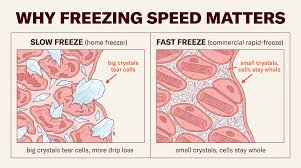

Freezing sounds like the simplest way to preserve something: lower the temperature and wait. For proteins, antibodies, enzymes and many vaccine components, it is far more delicate than that. How fast a liquid freezes, how evenly the cold reaches every part of the container and how it is thawed again can decide whether a batch of drug substance keeps its quality or quietly loses part of its activity.
That is why pharmaceutical manufacturers treat freezing as a controlled process step rather than a storage detail. Dedicated blast units, such as an SLBU Freezer, use forced, directed airflow to pull large volumes of liquid product down to ultra-low temperatures and to thaw them in a controlled way, so that every bottle or bag on a load experiences roughly the same conditions. The physics behind that requirement is worth understanding.
What happens inside a freezing bottle
Water in a protein solution does not freeze all at once. Ice starts forming at the surfaces closest to the cold, usually the walls and the bottom of the container, and a freezing front then moves inwards. Ice crystals are almost pure water, so as they grow, they push dissolved substances – the protein itself, salts, buffers, sugars – into the shrinking pocket of liquid that remains.
This effect is called cryoconcentration, or freeze-concentration. The last part of the liquid to freeze, typically near the centre of a large container, can end up with a much higher concentration of solutes than the original solution. For a protein, that is a stressful environment. Molecules are crowded together, the chemical surroundings change and the risk of aggregation rises.
Buffers add another complication. Some buffer components can crystallise out during freezing, which can shift the pH of the remaining liquid. Sodium phosphate buffers are the textbook example. A protein that is perfectly stable at its formulated pH may be exposed to very different conditions for a period while the container freezes.
Why slow and uneven freezing is the real enemy
In a small vial, these processes play out quickly and fairly uniformly. In a multi-litre bottle or a bag of bulk drug substance, they do not. If a large container is simply placed in a static freezer, the outer layer can freeze long before the core. The longer the centre remains liquid, the longer the most concentrated part of the solution is exposed to those stresses.
Ice itself also matters. The boundary between ice and liquid is an interface where proteins can unfold, and the size and structure of the ice crystals depend on the cooling conditions. Researchers studying freeze-thaw stability generally aim for conditions that are fast enough to limit time in the concentrated state, and above all reproducible, so that every batch goes through the same history.
That last point is crucial in regulated manufacturing. A freezing step does not need to be the fastest imaginable; it needs to be characterised, consistent and supported by data showing that the product comes out within specification.
Thawing is half of the story
The same physics works in reverse. During thawing, the frozen block melts from the outside in, and concentrated regions can again appear before everything is liquid. Uneven thawing can leave part of a container sitting at higher temperatures for longer than intended while the core is still frozen. Controlled thawing with directed airflow, rather than leaving containers on a bench or in a water bath, is one way manufacturers reduce that variation.
Several practical factors influence how a product behaves during freeze and thaw:
- Container geometry: thinner, flatter shapes freeze and thaw more evenly than tall, wide bottles.
- Fill volume: overfilled containers take longer to freeze through and can crack as ice expands.
- Load configuration: spacing between containers determines how well cold air reaches each one.
- Formulation: excipients such as sugars are often added to protect proteins during freezing.
- Number of cycles: repeated freezing and thawing adds stress, so most processes try to limit it.
A quiet step with big consequences
To most people, a freezer is a box that gets cold. For the teams producing modern biologics, freezing and thawing are engineering problems that touch protein chemistry, heat transfer and process validation all at once. Getting them right does not make headlines, but it is part of why medicines that are made in one place, stored for months and shipped across continents still work the way they should when they reach patients.
Leave a Reply