Here is a math problem most “best repricer” articles forget to ask.
You sell a $1,200 product. Your repricer makes a mistake and lets it sell at $980 because it confused a competitor’s price-error listing for a legitimate competitive offer. You sell one before you notice. That single mistake just cost you $220. You did not lose $220 of revenue, you lost $220 of margin from a sale you were already going to make.
Now imagine that mistake happens twelve times in a quarter on different SKUs.
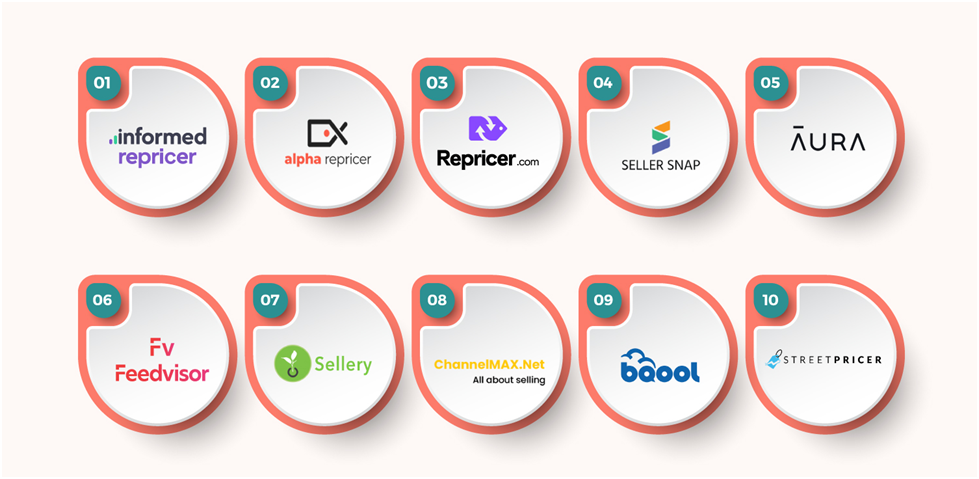
This is the math high-ticket sellers live with every day. At $20 per unit, a repricer error is mildly annoying. At $1,200 per unit, a repricer error is a paycheck. So the tools below were not chosen for speed or marketing flash. They were chosen for the boring, unsexy features that protect you from the specific failure modes that cost high-ticket sellers real money. Here are the ten worth knowing about in 2026.
1. Informed Repricer
The failure mode it helps reduce: pricing anomalies that can trigger listing suppressions, disrupt visibility, and delay sales while the issue is resolved.
- Includes features designed to help sellers avoid pricing-related listing suppressions and maintain pricing within safe operating ranges
- Optimal Price algorithm that works even on listings with no direct competitors
- 21 Amazon marketplaces plus Walmart support
- Flat-fee monthly pricing with unlimited listings on most plans
Listing suppressions are a low-frequency, high-cost failure for high-ticket sellers because the recovery time is measured in days, not hours. Informed’s pricing safeguards are genuinely useful here.
2. Alpha Repricer
The failure mode it protects against: setting min and max prices manually on a deep catalog of high-value SKUs, getting one formula wrong, and discovering the error only after a SKU sold below cost.
- Formula-based bulk min/max using acquisition cost, shipping, and Amazon fees applied across your catalog
- Buy Box Hunter algorithm that targets the Buy Box at the highest profitable price, not the lowest
- Yo-Yo Repricing for controlled upward price testing within your boundaries
- Smart filters to exclude irrelevant sellers like FBM with two-week shipping who would not win the Buy Box anyway
- Separate competitor logic per fulfillment type (Amazon, FBA, SFP, MFN)
- 23 Amazon marketplaces with local-currency display
- 14-day free trial with no credit card required
For high-ticket sellers specifically, the formula-based bulk approach is what prevents manual entry errors at scale, and the Yo-Yo Repricing is what tests upward price movement within your safety boundaries.
3. Repricer.com
The failure mode it protects against: setting your minimum price from sticker rather than from real economics, then accidentally selling at a loss because the “floor” did not actually account for what each sale costs you.
- Net Margin Repricing on higher tiers calculates your minimum price using real FBA fees, fulfillment costs, and shipping
- Fast automated repricing designed to react quickly to competitive changes before they significantly impact Buy Box performance
- Multi-channel pricing across Amazon, eBay, Walmart, and Shopify
- AI Buy Box Optimizer that targets the Buy Box while respecting your real-cost floor
For high-ticket sellers, Net Margin Repricing is the difference between a tool that calculates your minimum correctly and one that lets you sell at a quiet loss every time fees shift.
4. Seller Snap
The failure mode it protects against: getting dragged into a race-to-the-bottom price war by an AI competitor that does not care about margin, watching your high-ticket margin compress 15% in 72 hours.
- Game theory algorithm that detects and avoids price wars instead of participating in them
- Cooperative pricing logic to keep prices stable when the market allows it
- Near real-time reaction through Amazon’s latest API
- AI-driven strategy with no rule-writing required
High-ticket categories often have just a handful of serious sellers, which makes cooperative pricing genuinely viable as a strategy. Seller Snap is built specifically for this dynamic.
5. Aura
The failure mode it protects against: a margin-aware AI that gets too aggressive on the Buy Box chase and quietly erodes your premium positioning.
- Maven AI engine designed around margin optimization rather than pure Buy Box chasing
- Workflows feature for applying different repricing logic to different listing groups
- Hyperdrive accelerated repricing on a selected listing count
- Amazon and Walmart coverage from one dashboard
Aura’s design philosophy fits high-ticket sellers naturally because the platform was built around margin protection from day one.
6. Feedvisor
The failure mode it protects against: underpricing a high-ticket SKU because the AI did not factor in broader market conditions when making pricing decisions.
- AI considers multiple pricing signals, including inventory levels and market conditions, when optimizing prices
- ProductSphere technology maps competition at the SKU level
- Integrated repricing, advertising optimization, and brand analytics
- Amazon and Walmart support
For established high-ticket brands with revenue at scale, the integrated intelligence layer is where the value is. Feedvisor is enterprise software, and the pricing reflects that.
7. Sellery
The failure mode it protects against: setting a floor on a high-ticket SKU that does not move with your cost basis, then continuing to undercut even after your supplier raises prices.
- Dynamic Minimum Price calculator that pulls in your real cost, shipping, and Amazon fees
- Smart Lists for slicing your catalog by sales velocity, stock age, or custom fields
- Real-time repricing engine
- Consultations with Amazon experts available
The dynamic min price feature is the specific high-ticket-relevant capability here, since high-ticket inventory cost data changes often and manual updates are where errors happen.
8. ChannelMAX
The failure mode it protects against: violating MAP (Minimum Advertised Price) policies on branded high-ticket inventory and getting penalized by the brand or losing distribution.
- MAP enforcement built into the repricer
- SKU-level strategy assignment for inventory groups
- Sales velocity logic for slow-moving high-ticket items
- Amazon Business Pricing automation alongside standard repricing
High-ticket sellers often deal with branded inventory under MAP agreements. A repricer that natively enforces MAP rules is the difference between a clean reseller relationship and an awkward call from the brand.
9. BQool
The failure mode it protects against: setting minimum prices based on rough margin guesses rather than precise ROI targets, then realizing the math was off only after multiple sales.
- Built-in ROI calculator that auto-sets min and max from your target margin
- Conditional Repricing that switches strategies based on inventory age or sell-through rate
- AI Win Buy Box, AI Match Buy Box, and AI Match Boost Profit strategies
- Rule-based repricing alongside AI for fine-grained control
The ROI calculator is the high-ticket-relevant feature here because it removes the math errors that compound expensively on high-value inventory.
10. StreetPricer
The failure mode it protects against: losing the Buy Box on a high-ticket SKU because your FBA and FBM offers are quietly competing against each other.
- Multi-fulfillment logic so FBA and FBM work together to win the Buy Box
- Velocity-based repricing for items with no direct competitors
- Brand and tag-based price management
- Marketplace-specific pricing controls for different competitive environments
- Multi-account support across Amazon and eBay without per-store fees
For high-ticket sellers running multi-fulfillment, the fact that StreetPricer treats your offers as a coordinated team rather than rivals is the specific feature worth knowing about.
Four Mistakes High-Ticket Sellers Keep Making (And How Your Repricer Should Catch Them Before They Catch You)
Most of what kills a high-ticket Amazon business is not dramatic. It is not Amazon suspending your account or a supplier going bankrupt. It is small, quiet errors that compound week after week until someone runs a margin report and the numbers do not add up. The four mistakes below are the ones experienced high-ticket sellers have seen the most, and the repricers worth using are the ones that catch these before you do.
The competitor with a typo just cost you $400.
Picture this: a competitor selling the same $1,200 product accidentally lists it at $89 because of a feed import error or a fat-finger moment in Seller Central. A bad repricer sees that $89 listing and thinks “competitive offer detected.” Your tool obediently drops your price to $86 to win the Buy Box. The fat-finger seller realizes their mistake and corrects within an hour, but you have already sold three units at $86 each. That is not a $3 loss per unit. That is roughly a $1,000+ loss on a sale you were going to make at full price anyway. The repricers worth using either filter out obviously anomalous competitor data or let you set absolute floors that do not move even when competitor prices do.
Your floor is not your floor if it does not include fees.
Most sellers set their minimum price using mental math from their cost. Cost was $700, target margin is 30%, minimum is $910. Done. Except they forgot the FBA fee, the referral fee, the storage charge, and the return rate. The actual minimum that delivers 30% margin after fees is closer to $1,070. So every “minimum price” sale is actually a sale at half the margin they thought, and they only find out at quarterly tax time. Tools with Net Margin Repricing (Repricer.com, Informed) or formula-based min/max (Alpha Repricer) prevent this by doing the math from your actual fee structure, not your gut estimate.
The 72-hour invisible price war that compressed your margin by 15%.
You go to a conference on a Friday. You come back Monday morning. While you were gone, three competitors with aggressive AI repricers got into a loop, each undercutting the other every two minutes for 48 straight hours. Your repricer, by default, followed them down. Your high-ticket SKU that was selling at $1,180 on Friday is now sitting at $1,020. None of you have actually gained Buy Box share. You have all just collectively burned 15% off your margins for no reason. Game theory repricers like Seller Snap are specifically built to detect this dynamic and refuse to participate, which sounds abstract until you realize how much it actually saves at high ticket.
The listing that died on a Tuesday because Amazon thought $740 looked suspicious.
Amazon has internal pricing safeguards designed to detect unusual pricing activity. When your listing falls outside expected pricing ranges, visibility can be affected or additional review may be triggered. On a $20 SKU, you find out fast and fix it in 20 minutes. On a $1,400 SKU that you accidentally reprice to $740 on a Tuesday afternoon, the issue may go unnoticed for days, costing valuable sales while you investigate and correct it. Recovery can require account review, pricing updates, and time. Tools that include safeguards against unusual pricing behavior help reduce the risk of these issues occurring in the first place.
Final Thoughts
High-ticket Amazon selling is a margin business, not a volume business. Every percentage point you give up on a sale matters more than it would at lower ticket prices, which is why the repricers worth using are the ones that protect your floor first and chase the Buy Box second.
Pick two tools from this list and run them in parallel on a representative sample of your real inventory for two weeks. Track not just Buy Box minutes won, but average sell price compared to your max and average net margin per unit. The tool that holds margin while still keeping you competitive at the highest sustainable price is the one paying for itself. At your price points, that difference adds up fast.
Leave a Reply