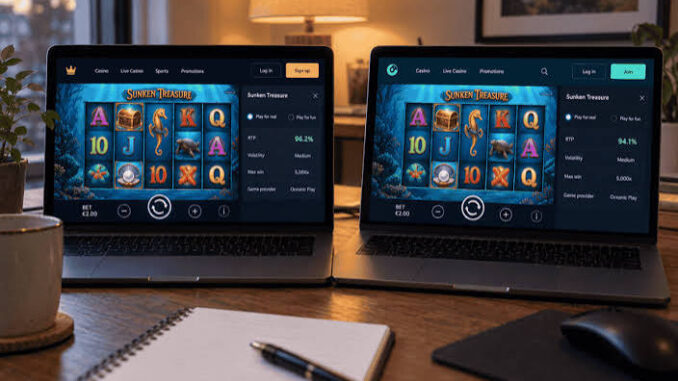
A review you’ve just read gives Book of Dead an RTP of 96.21%. You open it at a casino, look through the rules, and find 94.25%. You may have found another version of the slot, rather than an error in the review.
You might feel like skipping the rules of a game you’ve played many times before. There doesn’t seem to be much to gain from reading about symbols and features you already know. Most of us wouldn’t bother. The RTP is a reason to make an exception, because a familiar game can be supplied with a different published return.
Five Settings for the Same Slot
The 96.21% figure isn’t made up. It’s one of five RTP settings documented for Play’n GO’s Book of Dead. The others are 94.25%, 91.25%, 87.25%, and 84.18%. So a review can get the number right and still leave out something a reader would want to know.
RTP, short for return to player, describes the share of total stakes a game is designed to pay back over a very large amount of play. It isn’t the percentage of a deposit someone can expect to recover by the end of the night. That’s a different question, with no dependable answer.
The differences aren’t just theoretical. A comparison of 11 UK-facing casinos found Book of Dead running at three different RTP settings. Six offered 94.25%, four had 91.25%, and only one showed 96.21%. That’s quite a difference for a game that looks identical across those sites. Someone relying on the commonly quoted 96.21% figure could easily end up playing a version with a lower return.
The Game Name Only Gets You So Far
Let’s say you want to deposit with MobilePay. Casino Banking Methods lists casinos that accept MobilePay, which can help narrow down the places to check. Looking through their game libraries is easy enough after that. Book of Dead is either listed, or it isn’t.
Finding the title at two casinos may feel like the end of that part of the search. Both have the slot, and both accept the preferred payment method. Yet one could have Book of Dead at 96.21% and the other at 91.25%. The games might look identical when opened.
It’s easy to see how that gets missed. A lobby thumbnail tells you the title and usually shows a familiar piece of artwork. It doesn’t necessarily tell you which RTP setting is behind it. That information may be a few taps further in, among the game’s help pages.
A Few Points on RTP, More Than Twice the House Edge
The difference between 96.21% and 91.25% doesn’t look enormous at first. Try turning the figures around. The house edge, the part of the stakes the game is designed to retain over time, rises from 3.79% to 8.75%. The second figure is more than twice the first.
For €1,000 wagered, that works out to a theoretical loss of €37.90 on the higher-return version and €87.50 on the lower one. Nearly €50 separates them. Neither amount is a prediction for a particular player, but the comparison shows why the setting deserves more attention than the game’s thumbnail.
The €1,000 is money wagered, not necessarily money deposited. Someone could deposit €50, win €8 from a €1 spin, and use that €8 for eight more spins. Those nine €1 bets add up to €9 wagered, even though the player didn’t put another €8 into the account. RTP calculations count the repeated betting too.
And a higher RTP won’t make every playing session better. Book of Dead is a volatile slot. The free-spins feature can produce a big return, but there may also be stretches where very little comes back. Neither a bad hour nor one unusually good bonus can show which RTP version is running.
This is also why RTP and volatility shouldn’t be confused. Two games might have similar returns but distribute their prizes quite differently. One could produce smaller wins more often, while another relies heavily on occasional large payouts. The RTP figure alone doesn’t tell you how comfortable or frustrating a session will feel.
Who Decides Which Version You Get?
The five Book of Dead settings come from Play’n GO. They’re configurations of the game that a casino may be able to offer, depending on its arrangements with the developer and the rules in its market.
That isn’t the same as the casino quietly adjusting a player’s RTP after a win. The point is that two casinos may have selected different versions before the player even arrives. Nothing about recognizing the symbols or knowing how the bonus works settles which one is available.
It also explains why comparing a game’s name alone can be misleading. A casino with the larger slot library isn’t automatically offering the higher RTP. Nor does a generous welcome offer tell you anything about the return attached to a particular game.
There’s another reason these differences can go unnoticed. Players tend to remember the parts of a slot they can see. Book of Dead still has its Egyptian theme, the familiar book symbol and the expanding-symbol feature during free spins. Someone who has played it for years might recognize all of that immediately. The mathematics behind those features isn’t something that becomes obvious after a few spins.
The Number to Check Before Playing
Suppose the casino’s description says Book of Dead has a 96.21% RTP, but the rules inside the slot say 94.25%. That leaves a question the game description hasn’t answered. The text may be out of date, or it may refer to a different configuration.
The game’s own help or information menu is the first place to check. If the percentage isn’t there, or two pages disagree, ask support which version is currently running. A screenshot of the figures is more helpful than a vague question about whether the game is fair.
It’s worth checking the date on a review as well. An article written for a particular casino last year might still explain Book of Dead’s symbols and free spins perfectly. Its RTP figure may not describe what the same casino offers today, much less what another site has loaded.
Even when a review quotes the developer’s official figures, there’s a distinction between documenting the available versions and confirming the one a casino actually uses. The first tells you what the game can offer. The second tells you which percentage applies where you intend to play.
Once the percentage has been found, there’s no need to treat it as a forecast for the next spin. It’s a way of making a more informed comparison between versions. The reels can be just as familiar as ever; the number in the rules is the part worth looking at again.
Leave a Reply